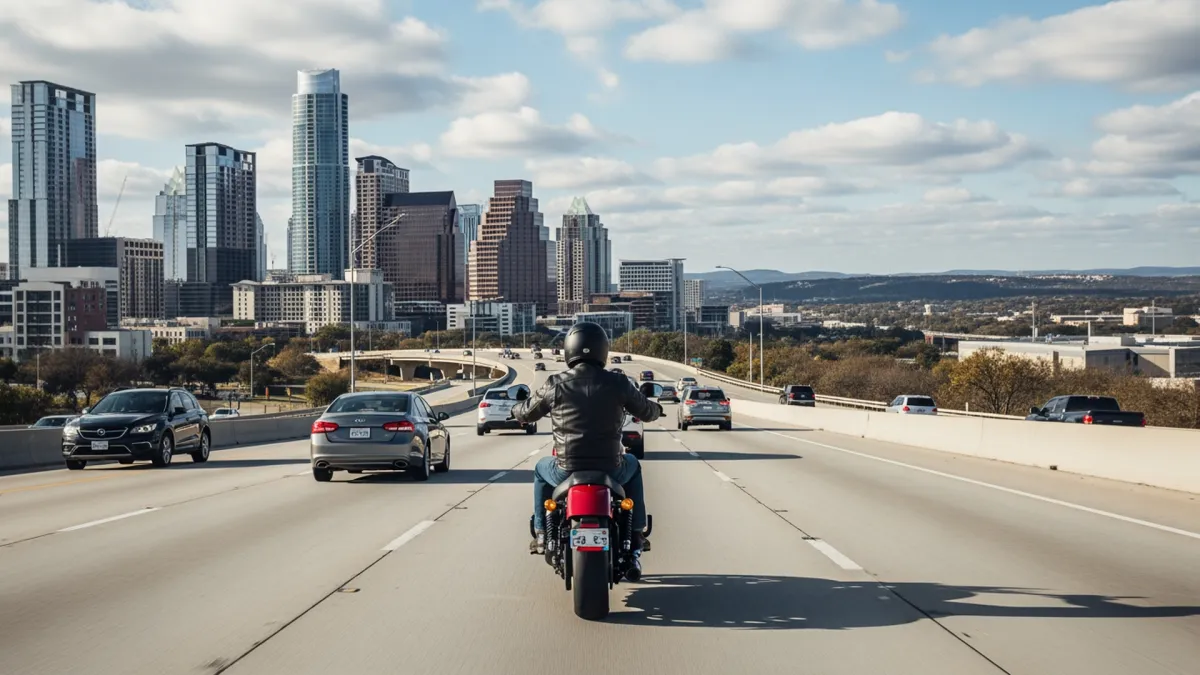
Uninsured & Underinsured Motorist Coverage: An Austin Rider's Real Backstop
Every rider who commutes on I-35 or carves the Hill Country loops has thought about it at least once: what happens if the driver who hits me has no insurance, or barely any? In Texas that is not a rare worry. It is a real possibility on any given ride, and the answer often comes down to a part of your own policy that most people never read closely.
What Texas Minimum Liability Actually Buys
Texas sets a floor for how much liability insurance a driver must carry, and that floor is written as 30/60/25. It means 30,000 dollars for bodily injury to one person, 60,000 dollars for total bodily injury per crash, and 25,000 dollars for property damage. Those are minimums, not generous cushions. A serious motorcycle crash can produce medical bills that blow past 30,000 dollars in the first hospital stay alone, and when the driver who hit you carries only the state minimum, that cap is all their policy offers no matter how large your injuries actually are. Some drivers on Central Texas roads carry no coverage at all, despite the law requiring it. That gap between what you are owed and what the other driver can pay is exactly what your own coverage is meant to close.
Uninsured vs. Underinsured: Two Different Gaps
These two coverages solve two different problems, and Austin riders benefit from understanding the split. Uninsured motorist coverage, or UM, applies when the at-fault driver has no liability insurance at all, or in many hit-and-run situations where the driver flees and cannot be identified. Instead of being left with nothing, you turn to your own UM coverage. Underinsured motorist coverage, or UIM, applies when the at-fault driver has some insurance but not enough to cover your losses. If their 30/60/25 policy runs out before your bills are paid, UIM helps bridge the gap up to your own limits. The everyday scenario looks like this: a driver turns left across your path on US-183, you are badly hurt, and their minimum policy tops out at 30,000 dollars while your real losses are far higher. Without UIM, that 30,000 dollars is the ceiling. With it, your own coverage can pick up where theirs failed.
Why This Coverage Matters More on a Motorcycle
Riders are exposed in a way drivers are not. The same collision that dents a car door can put a motorcyclist in the hospital for weeks, and that mismatch is exactly why UM and UIM carry so much weight for Austin riders. This is protection you buy for yourself, so your recovery does not depend on how responsible the other driver happened to be.
- ✓ Injuries tend to be more severe. Higher medical costs mean the other driver's minimum limits run dry faster.
- ✓ Hit-and-run is a real risk. A rider knocked down on a dark stretch of RR 2222 or the Devil's Backbone may never see the vehicle that caused it, and UM is built for exactly that.
- ✓ You are not at the mercy of a stranger's choices. Whether the other driver bought real coverage is out of your control, but your own UM and UIM is not.
- ✓ It follows you, not just the bike. Depending on your policy, this coverage can protect you in situations beyond a single vehicle.
- ✓ It cannot be added after the crash. UM and UIM only helps if it is already on your policy, so check your declarations page while you are healthy.
When Your Own Insurer Becomes the Opponent
There is an uncomfortable twist to UM and UIM claims. Because the money comes from your own policy, your own insurance company is now the one deciding what to pay, and that can put the carrier you have paid for years on the other side of the table, scrutinizing your injuries and your version of events much like the at-fault driver's insurer would. This is where riders are often caught off guard. They assume a claim against their own coverage will be simple and cooperative, but in practice a UM or UIM claim can be contested just as hard as any other, with disputes over fault, over the severity of injuries, and over how much the policy truly owes. In Texas an insurer generally has to make UM and UIM available when it writes your policy, yet people sometimes decline it to shave a few dollars off the premium without fully realizing what they gave up. Having someone who handles these claims for riders can keep an insurer honest about coverage you already paid for, and because Texas generally gives you two years to file suit, it is worth acting well before that clock runs tight.
Glen Larson and the motorcycle accident lawyers in Austin at Biker Wolf Pack represent riders hurt by negligent drivers. If you have questions after a crash, their team is here to help.
